
This article is for educational and informational purposes only and is not a substitute for professional medical advice, diagnosis, or treatment.
If you already know creams and oils don’t reach stretch marks, because the damage sits in the dermis, not the surface, covered in our guide on how to get rid of stretch marks, you are likely here for the real question: how does RF microneedling actually work on them, and what should you realistically expect. This is the practical, mechanism-level follow-up. Here is what a session for stretch marks actually involves, how many you will likely need, how long results take to show, and whether it works on marks that have already faded to white or silver.
How RF Microneedling Actually Improves Stretch Marks
RF microneedling improves stretch marks by working at the exact depth where the original damage happened. Fine needles create controlled micro-injuries in the dermis, while radiofrequency energy delivers heat at that same depth through the needle tips. Together, this triggers the skin’s natural repair response, fibroblasts activate and begin producing new collagen and elastin, gradually rebuilding some of the structure that was torn when the stretch mark originally formed.
A 2023 prospective clinical study published in the Journal of Cosmetic Dermatology, evaluating fractional radiofrequency specifically for stretch marks, described the mechanism in similar terms, reepithelialization, collagen shrinkage, fibroblast stimulation, and new collagen formation working together to improve the treated tissue. This is a fundamentally different approach than a topical product sitting on the skin’s surface, it is a controlled, repeatable stimulus directed at the actual site of the scarring.
What a Session for Stretch Marks Actually Involves
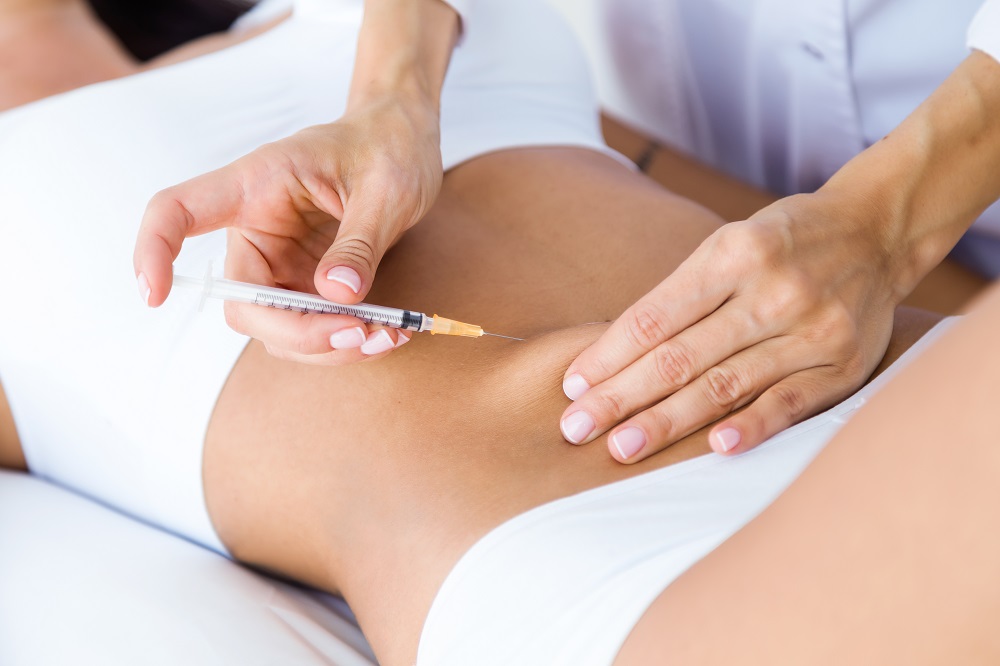
Body-area treatments for stretch marks, typically the abdomen, thighs, or arms, follow a similar structure to facial RF microneedling sessions, adjusted for the larger surface area. A topical numbing cream is applied roughly 30 to 45 minutes before treatment to keep the session comfortable. The provider then passes the device over the treatment area, most patients describe the sensation as mild pressure and warmth rather than sharp pain, since the numbing has taken effect by the time treatment starts. Sessions on body areas like the abdomen or thighs generally take longer than a facial session simply because of the surface area being covered. Your provider maps out the treatment zone in advance and adjusts needle depth and RF energy based on your skin thickness and the depth of the marks being treated, a personalized setting, not a single default applied to every patient.
How Many Sessions Does It Actually Take?
For stretch marks specifically, published research offers a useful benchmark. The 2023 fractional radiofrequency study for stretch marks used a protocol of four treatment sessions spaced four weeks apart, with outcomes formally evaluated at twelve and sixteen weeks after the final session. That four-session, four-week-interval structure is a reasonable starting expectation for most patients.
At Windermere MedSpa, general RF microneedling session counts run roughly two to three sessions for mild concerns, three to four for moderate concerns, and four to six for more significant ones, and stretch marks on body areas tend to land on the higher end of that range, both because body-area results generally take longer to develop than facial treatments and because stretch mark severity varies considerably from patient to patient. For more on how session counts are determined generally, see our guide on how Genius RF microneedling works. Your actual session count is set during a consultation based on the size, depth, and age of your specific marks, not a fixed number applied to everyone.
How Long Until You See Results?
Results build gradually rather than appearing right away, because they depend on collagen remodeling, a biological process that takes time regardless of the treatment. Some patients notice early texture changes within a few weeks of their first sessions, but the more complete, measurable improvement takes longer to show up.
In the stretch-mark-specific clinical study referenced above, meaningful volumetric improvement was not formally assessed until twelve and sixteen weeks after the final of four sessions, several months into the process. That timeline is worth setting expectations around from the start, rather than judging results after a single session or a few weeks.
Does It Work on Old (White or Silver) Stretch Marks?
Yes, and this is one of the real advantages RF microneedling has over topical treatments. As covered in our guide on how to get rid of stretch marks, retinoid creams mainly help early, still-red or purple marks because they depend on active inflammation still being present. RF microneedling works differently, it stimulates new collagen production directly, which does not depend on the mark’s original inflammation still being active.
That means mature, white or silver stretch marks, the ones that have essentially stopped responding to any topical product, remain reasonable candidates for RF microneedling. Results on older marks may take a similar or slightly longer course than on newer ones, but the treatment is not limited to only fresh marks the way most topical options are.
What Realistic Results Look Like
Consistent with what we say across our content on this topic, no treatment, including RF microneedling, fully erases stretch marks. What patients realistically see is meaningfully improved texture, softer transitions in color between the mark and surrounding skin, and reduced overall prominence, changes that make marks noticeably less noticeable rather than invisible. For many patients, especially those treating older, more established marks, that improvement is a significant and worthwhile change even though it is not a complete erasure. Setting this expectation upfront is more useful than a result that quietly falls short of an unrealistic promise.
Aftercare and Recovery
Recovery after RF microneedling on body areas follows a similar pattern to facial treatment. Redness and mild swelling are expected and typically resolve within 24 to 72 hours. Small pinpoint marks at the needling sites settle within a few days. Sun protection on the treated area is important during healing, and most patients are comfortable returning to normal activity within a few days of each session, making it realistic to treat before a weekend and be back to normal well before the next work week.
FAQs:
Q1. Is RF microneedling painful for body areas like the stomach or thighs?
Ans: Most patients describe it as mild pressure and warmth rather than sharp pain, since a numbing cream is applied 30 to 45 minutes before treatment begins. Sensitivity can vary slightly depending on the area and individual pain tolerance.
Q2. Can I combine microneedling with other stretch mark treatments?
Ans: Yes, some patients use a retinoid cream on newer marks alongside RF microneedling sessions, though your provider will guide timing since retinoids and exfoliating acids typically need to be paused in the week before each session.
Q3. Is RF microneedling safe for all skin tones on stretch marks?
Ans: Yes. Because RF energy is delivered below the skin’s surface through the needle tips rather than relying on surface-level heat or light, it carries a lower risk of post-inflammatory pigmentation changes across a broad range of skin tones compared to some laser options.
Q4. How long do results last once treatment is complete?
Ans: The collagen rebuilding stimulated by treatment is a lasting structural change, not a temporary effect, though stretch marks can still be influenced by future significant weight changes, pregnancy, or growth, the same original causes.
Q5. Ready to Map Out a Realistic Session Plan?
Ans: If you are ready to move past guessing and get a realistic plan based on the age, size, and location of your specific stretch marks, that starts with a consultation, not another product. Windermere MedSpa in Cumming offers a free 15 minute consultation, part of our current specials, to assess your marks and map out a session plan. Book online or call (470) 570-6727 to get started.